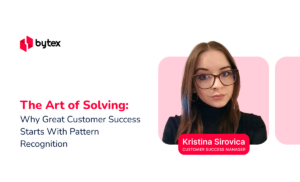
Kristina Sirovica has always paid attention to the details and patterns other people overlook: a subtle change in tone, an unexplained reaction, or the small inconsistency that changes how a situation should be understood.
As a Customer Success Manager at Bytex, that instinct has become an important part of her work. Acting as a bridge between clients and engineering teams, Kristina brings together different perspectives, traces problems back to their source, and makes sure concerns are understood before decisions are made.
We spoke with her about patterns, intuition, the discipline behind good observation, and why professional growth begins with taking responsibility for what you still need to learn.
This interview is part of our newest series, The Art of Solving, in which we meet the people behind Bytex through the way they think. Each conversation explores the experiences, instincts, and principles that shape how our colleagues approach difficult problems, work with others, and continue getting better at what they do.
Tell us about your role.
I’ve been working in customer success for about five years. My role is essentially to act as a bridge between our clients and our engineers. I manage communication in both directions, handle escalations, and make sure questions, comments, and concerns are addressed transparently and on time. When something needs urgent attention, I also make sure the right information reaches senior leadership.
You’ve been fascinated by crime, investigations, and investigative stories for a long time. Where do you think that fascination comes from?
I don’t think I’m drawn to the crime itself. What interests me is the process of understanding what really happened: noticing small details and patterns, then connecting the dots. I’ve been doing that since I was a child.
Looking back, I think my interest in crime and investigative stories has helped shape the way I naturally think and approach situations, both in my personal life and at work.
Do you think that interest changed the way you observe people and situations, or did it amplify something that was already there?
I think it amplified something that was already there. I’ve always felt that my intuition was strong, even as a child. Some of that may simply be innate, although your interests and experiences help you develop it and eventually bring it into your work.
When you watch someone solve a case, what are you paying attention to?
I pay attention to almost everything, especially what isn’t being said or shown explicitly. I look for details that may seem insignificant at first but become meaningful later. I try to connect them with what has already happened and with patterns I’ve seen before.
That applies when I’m watching a documentary or a series, but I also do it in real life. I tend to notice what people leave unsaid.
How does that show up in the way you observe people?
I pay attention to patterns, body language, tone of voice, word choice, and changes in behavior. If someone compliments my T-shirt, for example, I’ll notice the way they say it and the expression on their face, because those details can tell you whether they really mean it.
I also notice when someone begins avoiding a particular subject or changes the way they speak to me. I’m not sure how much of that comes from intuition, but it has helped me throughout my studies, my personal life, and my work.
When you enter a new situation, whether it’s a meeting, a customer conversation, or something outside work, what do you naturally notice?
I usually notice the atmosphere first and how the situation makes me feel. Is it pleasant? Is there tension? Does something feel off?
A recent example happened when I was having lunch with my husband and a group of friends. The waiter brought everyone’s food except my husband’s, then simply told us to enjoy our meal. I immediately said that he had forgotten the order. Everyone else thought the dish was probably taking longer to prepare, but the waiter hadn’t mentioned a delay or offered any explanation. After five or ten minutes, my husband asked him about it, and the waiter admitted that he had forgotten.
There was nothing dramatic in the interaction. I noticed the tone of his voice and the absence of the explanation you would normally give if one dish were delayed. It was a small detail, but it told me what had happened.
Do you think people can deliberately develop pattern recognition, or is it primarily instinctive?
I think it can be developed. The more varied experiences and situations you encounter, the easier it becomes to recognize similar patterns later. It may come more naturally to some people, but experience can teach anyone to become more observant.
How often does the real problem differ from the problem a customer initially describes?
It depends entirely on the client and the situation. Some clients make a problem sound catastrophic when the underlying issue is relatively manageable. In other cases, they are completely right to be angry. There is no universal rule, so you have to understand the context before drawing a conclusion.
What is your process for figuring out what is happening beneath the surface?
The first step is to gather information from both sides and speak with every relevant stakeholder. There are always several perspectives, and you need to hear them before taking action.
My previous experience as a Project Manager helped me develop this approach and has been very useful in my current role. Once I understand the different sides of the story, I use what I’ve learned from similar situations to find a solution that works for everyone involved. The essential part is gathering the complete picture before deciding what to do.
Are there questions you consistently ask because they help you uncover the real issue?
I always try to understand the root cause: why someone did something or why they are behaving in a particular way. I apply the same process to myself, asking why I responded to something the way I did and looking back at the steps that led there.
Breaking down what happened helps you structure the situation and get closer to the underlying cause. Sometimes this tendency complicates my life because I can overthink things, but in most cases it helps. It allows me to consider different outcomes and be better prepared for them.
What advice would you give junior colleagues who sense that something is wrong but aren’t sure whether to trust their intuition?
Prepare your reasoning. Gather the evidence, work through your thought process, and be ready to explain why you believe there is a problem. Intuition or common sense may help you notice that something is wrong, but you still need to build an argument that other people can understand and evaluate.
That is what I was missing at the time. I had a concern, but I hadn’t prepared the arguments that would have made my point clear and persuasive.
What does being proactive look like to you?
It means noticing things early and taking action before they escalate. In customer success, regular communication is essential – in other words, more patterns. Whether check-ins happen weekly, every two weeks, or monthly, you need to stay close enough to the client to understand what is changing and how quickly.
It also means doing your own research. You should follow the company’s website and LinkedIn page, speak regularly with the engineers, and stay aware of relevant internal developments. We don’t want surprises in customer success. Being proactive means gathering information continuously and responding at the right time.
Has AI changed the way customer success works or affected customer expectations?
AI affects almost everyone’s work today. In customer success, particularly within an outsourcing company, the change hasn’t been dramatic yet, but it is already useful for certain time-consuming tasks.
I prefer to write my own emails because communication is a core part of my role. If I outsource that entirely, I lose part of the thinking the job requires. The important thing is to identify where AI genuinely helps. At Bytex, we are exploring how to use it productively, including researching platforms that could help us track customer success more effectively.
For me, the goal is to use AI in ways that make my work easier without weakening my ability to think through situations myself so I can stay on top of patterns.
What belief have you changed or strongly reconsidered over the past five years?
It is less a belief I changed than something I became increasingly aware of: if you want to become good at your job, you have to take responsibility for your own development.
When I worked as a Project Manager, there were technical concepts I didn’t fully understand. No one was going to arrive and explain each one to me, so I had to research, explore, and educate myself.
Early in a career, it is easy to say, “That wasn’t covered during onboarding, so I don’t know how to do it.” That attitude doesn’t take you very far. You need to be willing to learn and improve on your own. This applies in my personal life as much as it does at work.
What are you still trying to become better at?
I want to deepen my understanding of technology. I don’t necessarily need to learn every programming language, but I want to stay informed, research unfamiliar concepts, and understand them in enough depth to be effective in my role.
I also want to learn more about AI platforms, tools, and concepts, including how they can support my work and benefit the company. Those are the two areas I’m most focused on developing now.